Thursday, February 14, 2013

Payroll tax changes result in $3 billion surplus in January

WASHINGTON | Tue Feb 12, 2013 2:44pm EST

(Reuters) - The budget posted a surprise surplus in January for the first time in five years, as the Treasury likely benefited from a windfall when payroll tax cuts expired.

The budget registered a $3 billion surplus, the first time there had been a surplus in January since 2008, Treasury Department data showed on Tuesday. Economists had been looking for a $2 billion gap. The surplus compared with a $27 billion deficit in January 2012.

It appeared the Treasury got a boost from the expiration of a payroll tax reduction on January 1 following the last-minute "fiscal cliff" deal. In its estimate last week, the Congressional Budget Office said the Treasury got an extra $9 billion in taxes from the expiry.

The January surplus means the government's cumulative deficit for the fiscal year, which starts in October, is $290 billion, 17 percent lower than the comparable first four months of fiscal 2012.

During fiscal 2012 which ended September 30, the budget deficit totaled $1.089 trillion.

Growth in receipts outpaced rising spending, narrowing the deficit. Receipts grew to $272 billion from $234 billion in the same month last year while outlays rose to $269 billion in January of this year from $262 billion in January 2012. So far in the first four months of fiscal 2013, receipts are $98 billion higher compared to the same period a year ago.

The extra fiscal space should leave the Treasury with plenty of room to stave off default after a debt-limit extension expires on May 19.

Congress on January 31 passed a measure that allows Treasury to borrow sufficiently to meet federal obligations until May 19, at which time another increase in the federal debt limit will be needed.

But even if no increase is granted, Treasury will be able to stave off a final day of reckoning until late July or early August by redeploying emergency cash management measures which allow it to claw back about $220 billion worth of borrowing capacity.

(Reporting by Anna Yukhananov; Editing by Andrea Ricci and James Dalgleish
Source: http://www.reuters.com/article/2013/02/12/us-budget-surplus-idUSBRE91B1E520130212
 
These posts are for informational use only to educate people about their online income taxes and the financial world around them. If you found this helpful, share the original article or this one, and help spread the word! With tax season rapidly approaching let us get you the best income tax return you can possibly have by e-filing! Leave us a comment if you want to share your opinion.
 
Please like us on Facebook: http://www.facebook.com/onlinetaxpros
and follow us on Twitter: @onlinetaxpros

Trends In Tax Planning From The New Tax Law

Steve Parrish
Steve Parrish, Contributor
Using my experience to help save business owners a headache or two.
 
We’ve had over a month to digest the American Tax Relief Act of 2012 (ATRA). The law is starting to take shape, and planners are devising strategies to leverage the good provisions and avoid the costly ones. Naturally, those of us who deal with these things each time they come around are being asked to make predictions about where this law will take us.

Predictions can be dangerous. What we take for prescience when the prediction is made may end up as being, well, foolish when the facts are all in. In the 19th century, the U.S. Geological Survey announced there was little or no chance of oil being discovered in California. In the 20th century, Neville Chamberlain famously declared peace for our time after signing the non-aggression pact with Nazi Germany. And, in the 21st century, the words mission accomplished come to mind.

Even with something as mundane as tax law, I’m hesitant to make predictions. I confess to past predictions such as ROTH conversions will be big and Congress will not let the estate tax expire in 2010. Time proved me wrong.  So, instead of predictions I offer tax trends.  These are my expectations for what may happen with tax planning as a result of the passage of ATRA.
  1. Income tax planning will take on an increased importance in business planning. With a slower economy translating to both lower earnings and lower yields, the incremental cost of increased income taxes will represent a larger potential drag on gains. Further, even though many individual income tax provisions have been made permanent, most of the business income tax provisions are temporary in nature. This may cause businesses to leverage business tax savings while they are available. Section 179 expensing, bonus depreciation and research & development (R&D) tax benefits are temporary at best, and businesses will take a hard look at enjoying these provisions before they expire.
  2. Tax diversification will have new meaning to business owners. In the Great Recession many business owners learned they couldn’t have all of their eggs in one basket — their businesses. Asset diversification is already a trend, but with increased taxes, there will also be a movement towards tax diversification. Business owners will, of course, look to qualified plans for immediate tax deductions, but they will consider tax advantaged products such as life insurance and annuities. The question is not just income tax deferral, but the nature of the income once it comes out. For example: accumulation-oriented life insurance policies will become more popular. That’s because they offer death protection and tax deferral during accumulation, plus tax-favored distributions where the owner can control the amount and timing of the income stream.
  3. Pass-through tax status will no longer be the only choice for smaller businesses. While electing S Corp or LLC (taxed as a pass-through) status will continue to be the default assumption for many closely-held businesses, tax planners are blowing the dust off of C Corporation (C Corp) law and giving it another look. One reason is tax brackets. The top C Corp tax bracket is 35%, while the top personal bracket is 39.6%. Further, C Corps offer tax favored benefits that are not equally available with pass-through entities. Group term life insurance, disability income plans and to an extent, health insurance, all enjoy preferred tax status for business owners when offered through a C Corp. Deferred compensation plans can truly defer some of an owner’s wages when structured through a C Corp tax status. Speaking of deferring compensation ….
  4. Deferred compensation plans will be very popular. With the passage of ATRA, top tax rates have gone up, and there is little reason NOT to defer tax if and where possible. Additionally, there will be tax points where the marginal cost of additional tax can be significant. For example: a couple may be well advised to keep its income below $250,000 in order to avoid the 3.8% Medicare surtax. Or, they may want to keep income below $300,000 to avoid the wasting away of their personal exemptions and itemized deductions. Many wage-earning taxpayers will seek to model these tax points in advance and, using deferred compensation plans from their companies, push off the sting of additional taxes until later.
  5. Estate planning will be noticeably different, depending on the estate side. With the exclusion from estate tax at the $5.25 million level ($10.5 for a couple), there are some interesting planning challenges. In many states, this means business owners won’t have to worry about the liquidity challenge of state or federal estate taxes in their planning.  However, in other states, although safe from the Feds, they will have to consider local taxes. Another complicating factor is that once the estate exceeds the exclusion, the taxes are large and the planning opportunities are even larger. The 40% rate that applies above the exclusion is onerous, but the law allows many opportunities to avoid it. Consequently, we will likely see a very different set of estate planning approaches, depending on the projected size of the estate at the time of death.
  6. Nothing is so certain as change. From the conversations I’ve had with business owners and their advisors, many are not buying that we’ve seen the last of tax law changes in the near future. We have so many deficit and budget issues to wrestle with in the coming weeks and months, many believe that Congress may be forced to revisit taxes sooner rather than later. Of course, I don’t mean this as a prediction. 
Source
 
These posts are for informational use only to educate people about their online income taxes and the financial world around them. If you found this helpful, share the original article or this one, and help spread the word! With tax season rapidly approaching let us get you the best income tax return you can possibly have by e-filing! Leave us a comment if you want to share your opinion.
 
Please like us on Facebook: http://www.facebook.com/onlinetaxpros
and follow us on Twitter: @onlinetaxpros

Thursday, February 7, 2013

Tips for Filing Your Tax Return For Free

The IRS has made it very easy to prepare and electronically file your own income tax return through Free File at no cost. I recommend this route for anyone who is comfortable filing his or her own income tax return and has an uncomplicated tax return with an adjusted gross income (AGI) of $57,000 or less. Usually this is a taxpayer with one or two W2s and taking the standard deduction.

To use the program, simply visit the IRS website and click on “Free File” located on the right side under the orange bar entitled “Filing and Payment.” This takes you to another location where vendors offer free filing as a service to the general public. Some vendors have age and resident state requirements, but there are plenty of vendors and it’s important to review the list to find the best fit.

The programs are easy to follow and require you to input your personal data as well as specified data from your W2 form. When complete, click the button to electronically file your tax return. You can even choose to have your refund direct deposited.

If you live in a state that levies an income tax, you may have to visit your state’s taxing agency website to prepare and file your state income tax return, which means inputting your data all over again. So look for one of the Free File vendors who offer assistance with state tax preparation. Some vendors allow you to file state income tax returns for free while others charge a fee, so make sure you review all the details.

For those who earned more than $57,000, you may still file for free. There are free online forms available, and both options allow people to file returns electronically and use direct deposit, which is the fastest way to get refunds.

If you are a senior citizen, you may access the IRS Volunteer Income Tax Assistance and Tax Counseling for the Elderly partners who will e-file your return for free. Some states offer tax preparation services for low-income filers.

More than 80% of all American taxpayers now file their tax returns electronically. There has never been a reported security breach at the IRS, and the agency claims to have “processed more than 1 billion individual tax returns safely and securely since the nationwide debut of electronic filing in 1990.”

The IRS generates refunds at a faster pace when a tax return is filed electronically. It makes sense: If you paper file your tax return, you must wait for the post office to deliver your return to the IRS. The return then must be keypunched into the system, which makes room for an error. By the time your tax return is processed and the refund check released it’s probably a good 5-10 days longer than if you had transmitted the data electronically.

The fastest way to get your refund is through direct deposit to your bank account. It takes time to prepare a paper check and then there’s the long journey from the IRS service center to your mailbox.

If you owe tax, you can e-file whenever you want then set an automatic payment date anytime on or before the April 15 deadline. You can pay by check or money order, by debit or credit card, or by transferring funds electronically from your bank account. If you do not transmit the funds electronically and prefer to mail a paper check, you must print a voucher – IRS Form 1040-V to send with your check. Make sure to put your Social Security Number and tax year on the memo line of the check.

If you cannot file your tax return by April 15, you may file for an extension using IRS Form 4868 – also available via Free File. Just remember that an extension is only for extra time to file, not for extra time to pay.
If you would like a volunteer to help you prepare the return via Free File, go to IRS.gov and search for “VITA” to find a volunteer-equipped self-preparation site location near you.

Bonnie Lee is an Enrolled Agent admitted to practice and representing taxpayers in all fifty states at all levels within the Internal Revenue Service. She is the owner of Taxpertise in Sonoma, CA and the author of Entrepreneur Press book, “Taxpertise, The Complete Book of Dirty Little Secrets and Hidden Deductions for Small Business that the IRS Doesn't Want You to Know.” Follow Bonnie Lee on Twitter at BLTaxpertise and at Facebook. 
 
 
These posts are for informational use only to educate people about their online income taxes and the financial world around them. If you found this helpful, share the original article or this one, and help spread the word! With tax season rapidly approaching let us get you the best income tax return you can possibly have by e-filing! Leave us a comment if you want to share your opinion.
 
Please like us on Facebook: http://www.facebook.com/onlinetaxpros
and follow us on Twitter: @onlinetaxpros

Wednesday, February 6, 2013

Connecticut Considers 10% Tax on M-Rated Games


http://blogs-images.forbes.com/insertcoin/files/2013/02/conn.jpg

A few weeks ago, I wrote a column detailing how video games are now being treated like a dangerous controlled substance on par with cigarettes, as new proposals around the country want games to endure extra taxes and over the top warning labels in the wake of tragedies like Sandy Hook.
 The tax in question the first time around was a 1% tax on “violent” games, including all Teen, Mature and (non-existent) Adults Only rated titles. The bill was proposed by Rep. Diane Franklin (R-Missouri), and was eye rolling at best.

But what’s better than a 1% tax? A 10% tax, which is now being proposed in a bill crafted by Connecticut state representative Debralee Hovey (R). Here’s the text of the bill:
“That the general statutes be amended to establish a sales tax on the sale of video games rated “mature” at a rate of ten per cent on the entire sales price and to require the moneys derived from such sales tax be used by the Department of Mental Health and Addiction Services for the purpose of developing informational materials to educate families on the warning signs of video game addiction and antisocial behavior.”
This is of course punishing an industry based on conjecture, as no concrete evidence has yet been put forth linking video games and violent actions. The Obama administration’s new gun plans do involve the NHS studying this link, but as nothing is proven (and likely won’t be), video games should not be treated in the same way as a product proven to cause cancer.

I do agree that video games can be addictive, and in some cases can result in anti-social behavior. What I do not believe is that parents are so dense that they’d need a federally funded program telling them that if they’re kid is locked in his room for eight hours a night playing Call of Duty, he may be addicted and is being anti-social. At that point, it’s clear the parents simply can’t be bothered to curb the behavior, and such a program would do nothing to change their minds.

I am not parent yet, but I cannot picture a scenario where a mother or father would have zero idea what sorts of games their kids or playing, either before or after purchase. If R-rated movies tell us that kids should probably not see that film, it takes all of two seconds to learn that an M-rating means that kids should probably not play that game. And do we really have to say out loud that letting your kid hole up in his room for an eternity playing games isn’t the best idea? What “education” past that is really necessary here?

Source: http://www.forbes.com/sites/insertcoin/2013/02/06/connecticut-considers-10-tax-on-m-rated-games/
 
These posts are for informational use only to educate people about their online income taxes and the financial world around them. If you found this helpful, share the original article or this one, and help spread the word! With tax season rapidly approaching let us get you the best income tax return you can possibly have by e-filing! Leave us a comment if you want to share your opinion.
 
Please like us on Facebook: http://www.facebook.com/onlinetaxpros
and follow us on Twitter: @onlinetaxpros

President Obama Warns That More Tax Increases Could Be On The Horizon

After five weeks and approximately 4,000 webinars, Americans are finally getting up to speed on the tax changes emerging from the year-end fiscal cliff deal. But if the President has his way, we may find soon be back at the drawing board, trying to make sense of a new batch of tax increases.

While the late-December negotiations accomplished the necessary task of addressing the expiring Bush tax cuts, the other half of the fiscal cliff – the scheduled cuts in spending that were slated to take effect on January 1, 2013 – were merely postponed, with the sequester now scheduled for March 1st.

On that date, approximately $85 billion in spending cuts will kick in, and if nothing changes, $110 billion in annual cuts will take effect on October 1st and continue for the next eight years. These cuts would hit defense spending hard as well as other domestic programs, such as education, housing, and Medicare.

Just as we saw with the fiscal cliff deal, however, neither political party wants the sequester to take effect as scheduled, as the indiscriminate cuts would deal a harsh blow to the still-recovering economy.

In a statement issued earlier today, President Obama proposed delaying sequestration in the near term in the hopes that Congress could use the additional time to compose a viable budget. The President would buy some time with a mix of alternative spending cuts and yes…you guessed it…additional tax revenue.

Specifically, the President stated that he would be willing to cut spending on social programs so long as they are done “hand-in-hand with a process of tax reform so that the wealthiest individuals and corporations can’t take advantage of loopholes and deductions that aren’t available to most Americans.”

The President offered no additional details, leaving those who follow this sort of thing to wonder exactly what type of loopholes might be on the chopping block. But if you look to the President’s previous but as-of-yet-unfulfilled tax proposals, and further consider that the stated goal of the current administration is to trim an additional $1.5 trillion from our deficit over the next decade in order to stabilize our debt, some big tax changes may be afoot. Changes like these: Read the full article to see the changes.
 
These posts are for informational use only to educate people about their online income taxes and the financial world around them. If you found this helpful, share the original article or this one, and help spread the word! With tax season rapidly approaching let us get you the best income tax return you can possibly have by e-filing! Leave us a comment if you want to share your opinion.
 
Please like us on Facebook: http://www.facebook.com/onlinetaxpros
and follow us on Twitter: @onlinetaxpros

Tuesday, February 5, 2013

The Tax Fight Continues

The tax fight isn’t over.
source: http://abcnews.go.com/blogs/politics/2013/02/the-tax-fight-continues/

Don't give up the fight,
even though the tax man may seem like this guy!
After Congress passed and President Obama signed a bill to allow automatic tax hikes on high incomes, Democrats and Republicans are fighting about taxes yet again.

In separate interviews over the weekend, Obama and Senate Majority Leader Harry Reid both said they will push for more revenue increases as part of another deal to avoid the looming “sequester” — automatic budget cuts that will take effect March 1, barring agreement on other deficit-reduction measures.

Both suggested closing tax “loopholes” as a way to raise more cash for the government.

“There’s no doubt we need additional revenue, coupled with smart spending reductions in order to bring down our deficit,” Obama said in an interview with CBS’s Scott Pelley. “Can we close loopholes and deductions that folks who are well connected, and have a lot of accountants and lawyers, can take advantage of, so they end up paying lower rates than say, a bus driver or a cop?”

Reid told ABC’s George Stephanopoulos that “without any question,” more revenue needs to be part of a follow-up deal.

“The American people are on our side,” he said. “The American people don’t believe in these austere things. We believe that the rich should contribute. We believe we should fill those tax loopholes — get rid of them, I should say. And that’s where we need to go.”

Republicans, needless to say, do not agree.

When the Senate reopened for business on Tuesday, Minority Leader Mitch McConnell devoted most of his speech to bashing the idea of new taxes instead of spending.

“If you were to listen to the Democrats, you would think that all our problems would be solved by raising taxes on private jets or energy companies,” McConnell said, arguing that tax hikes — even the so-called “loopholes” Democrats want to target — will drive jobs overseas. “They don’t want the facts to get in the way of a good political talking point.”

“That issue is closed,” Michael Steel, spokesman for House Speaker John Boehner, told ABC News. “President Obama got the tax hikes he wanted last month.  Washington has a spending problem, and that’s what President Obama and Senate Democrats need to address.”

It’s not that Republicans are totally opposed to closing tax “loopholes.” The conservative Club for Growth, which backs Republican primary candidates who support anti-tax policies, says it supports what Obama and Reid are pushing — but only as part of a broader deal on tax reform.

“We’d have to see what the legislation looks like. If it’s eliminating the sequester and just closing a bunch of loopholes without any tax reform, we’re opposed to it,” Barney Keller, the group’s spokesman, told ABC.

If it seemed that the tax part of the “fiscal cliff” was over, it isn’t: With Democrats pressing for revenue increases and Republicans pressing for only spending cuts, it appears both sides are where they were before the last agreement was passed and signed.
 
These posts are for informational use only to educate people about their online income taxes and the financial world around them. If you found this helpful, share the original article or this one, and help spread the word! With tax season rapidly approaching let us get you the best income tax return you can possibly have by e-filing! Leave us a comment if you want to share your opinion.
 
Please like us on Facebook: http://www.facebook.com/onlinetaxpros
and follow us on Twitter: @onlinetaxpros

Tax Breaks: Where Big Money Is

http://i2.cdn.turner.com/money/dam/assets/130204051128-chart-valuable-tax-breaks-2-monster.jpg


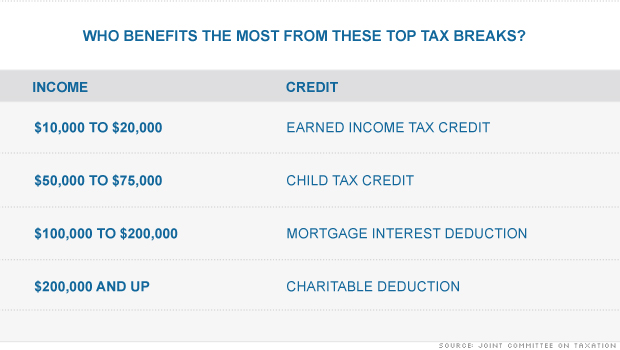
Those tax breaks mostly benefit powerful voting blocs: the middle-class and the wealthy.
The federal government gives up $1 trillion in revenue every year because of the hundreds of tax credits, deductions, exemptions and exclusions in the tax code. And the top 10 account for most of that $1 trillion. (Table of Top 10 here.)
 
Only one break in the top 10 is for corporations, which are allowed to defer paying federal income taxes on earnings by their foreign subsidiaries until that money is brought back to the United States. The deferral will cost federal coffers $265 billion over the next five years, according to new estimates from the Joint Committee on Taxation.

The JCT is the House-Senate panel that analyzes tax legislation. It released its latest line-by-line analysis of tax breaks on Friday.

The No. 1 break -- the health care exclusion -- will cost an estimated $760 billion over five years. The exclusion applies to the money a company contributes to help pay for an employee's health insurance coverage; the employer's contribution is treated as tax-free income to the worker.

The numerous tax breaks offered to individuals for retirement savings (in pension plans, 401(k)s and IRAs) come in a not-so-distant second at nearly $709 billion. Right after that is the lower rate on capital gains and dividends, which will cost federal coffers an estimated $616 billion over five years.

The popular mortgage interest deduction claims the No. 4 spot, with a $379 billion price tag. That's just above the $326 billion Earned Income Tax credit, the only tax break in the top 10 that primarily benefits low-income filers.

 
These posts are for informational use only to educate people about their online income taxes and the financial world around them. If you found this helpful, share the original article or this one, and help spread the word! With tax season rapidly approaching let us get you the best income tax return you can possibly have by e-filing! Leave us a comment if you want to share your opinion.
 
Please like us on Facebook: http://www.facebook.com/onlinetaxpros
and follow us on Twitter: @onlinetaxpros